Showing posts with label Japan. Show all posts

Friday, November 4, 2011

Tokyo

Our last stop in Japan was not just any stop, it was Tokyo, the largest metropolitan area in the world.

The expectations were of course set very high and we did not get disappointed. The neon lights, the people, the weird clothing, the food, the cars, karaoke all night, the electronics, the tempo, everything put together cannot be described, it must be lived!

As we had five days in Tokyo, we had to have a break from the madness in the middle. We therefore spent a day in Nikko, yet another world heritage area with temples and even more temples. Everything surrounded by the leaves changing colors and beautiful mountains.

Today we leave for Palau. Bye, bye Japan, we hope to see you again.

Tokyo!
Down town market


Karaoke
Okonomiyaki


Nikko

Yakushima

The locals say that in Yakushima it rains 35 days a month. During our time there it certainly did rain more than you would think possible for three days...

Yakushima is an island in Japan's southern archipelago. In 1993 it became Japan's first UNESCO world nature heritage site because of its Yakusugi cedar trees. These gigantic trees are often more than 1000 years old (up to 3000 years of age).

The large amount of rain fall together with the high peaks, the warm sub tropical weather during the summer and harsh winters have created a unique natural environment.

Yakushima is also known for its onsens (Japanese natural hot springs) that are found right by the sea. Some hot springs can be used at anytime of the day but others only at low tide. During high tide they are completely covered by the sea. It was an amazing experience to relax in these hot springs while the waves from the ocean came crashing in.

Despite the weather we were still able to enjoy long hikes among the cedar trees. After hiking for five hours through the pouring rain it was an amazing feeling to warm up and relax our tired muscles in the onsens.

Again we had chosen an accommodation in the lower price range. Lonely Planet's review of the place was simply "rough and ready". The review was very accurate but this time cheap and simple turned out to be a very good option.
Yakoshima ferry
Rough and ready hostel


Enjoying Japanese onsen

Yakoshima coast line


One night in Kagoshima

Our next stop after Hiroshima was the island of Yakushima. To get there we  had to first take the train to the city of Kagoshima on the southern tip of Japan. From there we would then have to catch a four hour ferry over to the island of Yakushima.

The ferry left at eight in the morning and the train ride from Hiroshima was three and a half hours long.  We had no choice but to stay in Kagoshima overnight. We were happy to find The Green Guest House hostel that was both cheap and located close to the ferry terminal.

It was to our surprise to see that this hostel was more of a flop house that was filled with permanent residents then a hostel for backpackers. The beds shook at night due to the heavy traffic. In the kitchen everything was so dirty that we had to re-wash our dishes before we dared using them.

Our night in Kagoshima taught us that "you get what you pay for" and that you just deal with it. For 20 francs a night in Japan you are better off sleeping in an internet café or at the train station.

We might not have had our best night sleep but we still got up the next morning and caught the ferry on time.

Tuesday, November 1, 2011

Miayima

Magnus was our tour guide for the day  on the island of Miayima. Miayima is a 10 minute ferry ride from Hiroshima. While approaching the island we got a great view of the "floating" torii (Shinto shrine gate). This gate is one of Japans most photographed tourist attractions.

After visiting the beautiful shrine where Magnus and Keiko got married we enjoyed some udon soup for lunch.  This gave us the energy to start our 2 hour hike towards the top of the island. The hike was fairly steep but well worth it in the end. On one side there was a great view of Hiroshima and on the other side a breathtaking view of the archipelago.

After taking in the stunning view from the top of the mountain we took the gondola back down to the bottom.


Monday, October 31, 2011

Okonomyaki

Okonomyaki is a traditional Japanese dish that is sometimes referred to as Japanese pizza or Japanese pancake. The word actually means "cook what you like". At an okonomiyaki restaurant there is a large frying plate in the middle of the table where everyone cooks his/her own dish.

The meal itself contains your own choice of meat, seafood,  eggs, vegetables and noodles. You mix everything together and start frying it into a pancake like shape.

Thanks to the guidance of Keiko and Magnus we were able to make our dishes look professional in the end. It was a delicious meal, we will be sure to cook it for our friends when we return home.

Hiroshima

We had a great time in Hiroshima both sight seeing and catching up with old friends.

After arriving in Hiroshima we met up with Pär's old university friend Magnus and his family. They took us to a restaurant where we got to try Okonomiyaki (Hiroshima style). In the afternoon that same day we then met up with Erika's old childhood friend Derek and his family. In the evening, Derek took us out for some more traditional Japanese food. This time it was grilled fish skewers and sashimi followed by some bar hopping.

The two most well known tourist sights in Hiroshima are the Miayima island and the atomic bomb museum. The day after we arrived in Hiroshima we spent a full day at Miayima with Magnus as our excellent tour guide.

During our last day in Hiroshima we rented bikes to get around the city. We rode the bikes to the atomic bomb museum. The museum is really interesting and is well worth a visit. Be aware though, during the week there might be hundreds of school children there on a field trip.

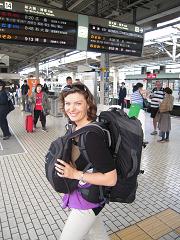
Ready to board the next bullet train
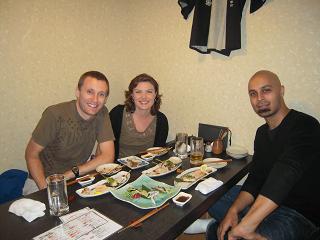
Enjoying fish dinner with Derek


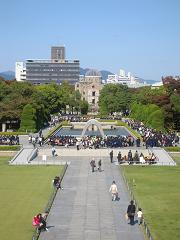
Hiroshima peace park

Saturday, October 22, 2011

Kyoto (or "How to overdose on temples...")

Kyoto might be Japans most famous tourist sight with its over 2000 temples and shrines. Whenever you see a photo from, read about or hear someone talk about Kyoto it is always about temples and shrines.

Arriving in Kyoto you therefore (at least we did) expect to step out of the train and straight into street after street with only temples and Japanese gardens. Instead you are met by the busy streets and apartment blocks of a city with 1.4 million people. However, once you start exploring the streets you discover temples and shrines almost everywhere. Some very small, tucked in between two concrete buildings from the sixties and some very large with enormous Japanese gardens that go on for acres. Once you enter these gardens it is like the busy city outside ceases to exist (unless you happened to end up in one of the most crowded tourist temples).

We really appreciated this mixture of both modern city and old temples and shrines. It is only possible to take in a certain amount of temples a day and it was nice to be able to escape from it every now and then. For example being able to find a sports bar so Pär could watch the rugby world cup final!

Japanese garden at Nijo-Jo castle
Kinkaku-ji, "the golden temple"

Soba noodles at Japanese table


Nijo-Jo castle, official Kyoto residence of the Tokugawa Shoguns.

The 1000 Torri gates
Issen-Yoshoku

Hakone

The Hakone district is a very popular tourist sight. It has interesting volcanic activity, provides a great view of Mount Fuji and it is also interesting from a historical point of view.

During the Edo era when the capital had been moved from Kyoto to Edo (now Tokyo) Hakone was used as a check point. Everyone traveling between Kyoto and Edo had to pass this check point and identify themselves.

Volcanic activity
View of Mt. Fuji-san


Taking in the nature
Walking among the old cedar trees from the Edo era


Kamakura

We started our visit to Japan by visiting Erika's old host family and friends in Kamakura. Kamakura is a small town so it was a great first stop to use for battling the jet lag. Even though small, the town still offers plenty of historical and cultural sights to visit, the most famous one probably being the great Buddha that was built in the 13th century.

It was so exciting to see old friends and family again. We were well looked after and had a wonderful time. We hope to see you all again!

Daibutsu, the great Buddha
Hase-Dera temple

Paper fortunes
Tsurugaoka Hachiman-gu shrine

Hase-Dera temple

Enjoing canned coffee

Friday, October 21, 2011

Laundry

After three days of traveling we had to do laundry for the first time. As we are planning on traveling for about 300 days, continuing at this rate would mean that we would have to do laundry 100 times.

Maybe we should have packed more than 10 kg per person...:-)

Bullet train

Riding Japanese commuter trains in rush hour with a 50 liter backpack is quite a challenge, you do take up quite a bit more space than the average person... This morning we did however not have much of a choice since we had to get to the station to catch the bullet train to Kyoto. Even though we thought we fought the crowd pretty well we sill managed to miss our train by 5 minutes. Luckily there was another train a bit later and we got to experience our first ride on a bullet train (shinkansen).

Shinkansen is Japan's high speed railway network. Its first line opened in 1964 and the trains run at a maximum speed of between 240 and 300 km/h.